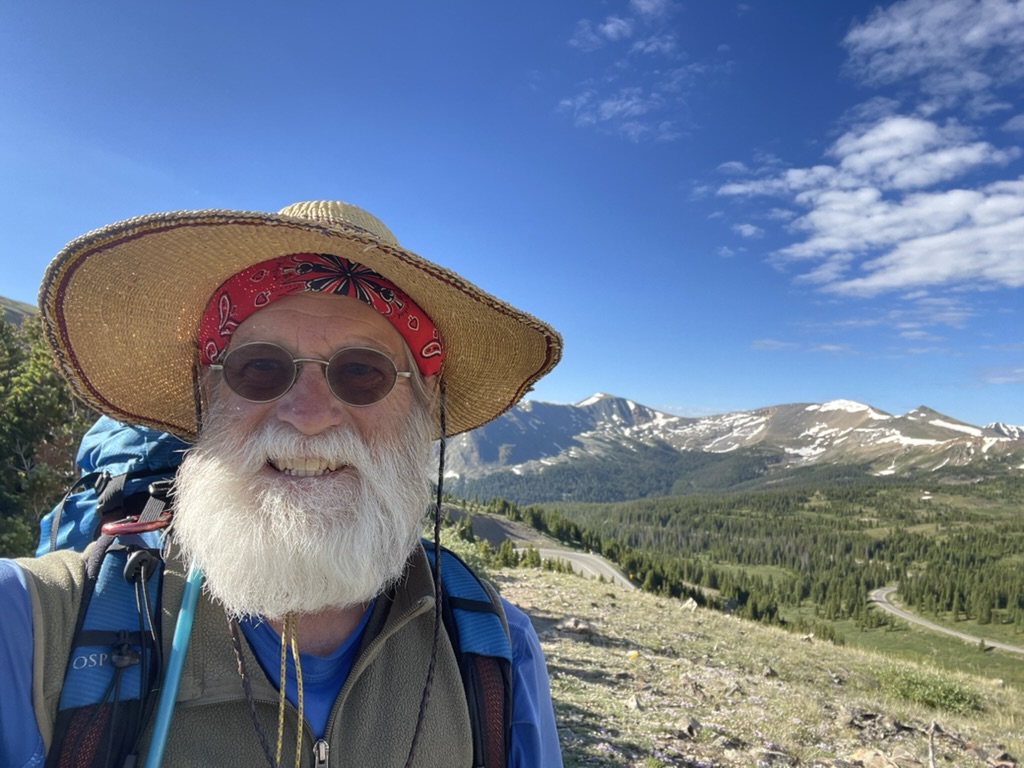
Allow me to wax philosophical about walking in the mountains as spiritual practice, and for me that means looking through a poetic rather than analytical lens. I don’t climb mountains to conquer them. When I reach a summit, I am thankful that the mountain didn’t throw me off. I am in awe of the majesty up there. I am not an eagle, hawk, falcon, or vulture and don’t soar on the winds. I am glued to the earth, feet allowing me to walk over its surface, feel gravity tug at my torso. That is my primary mode of moving. I also feel the higher altitude, changing my body, thinner air with less of what I need to survive, making me strain for breath, head spinning. Other hikers exalt in their “overcoming” of these challenges but not me. I haven’t overcome anything. I have been given a gift, allowed to enter a realm through the hospitality of the others who dwell there, opened to a thin place. When someone gives me such a gift my reaction isn’t to exalt in self accomplishment. I am humbled. I don’t humble myself, I am laid low, knees shaking, heart pounding, thankful. That leads me to a related spiritual practice that walking in mountains reveals. For me, it is not a practice of self-understanding. I don’t walk in the wilderness for self-revelation, to know myself. I recognize the validity of this philosophical and religious practice, so often referenced in Greek philosophy, alluding to Socrates, Plato, and Aristotle. But that is not my orientation in wilderness rambling. I want to know you! That is, the you who is the other in whose presence I am. I can never know you when I first focus on myself, when I strain to “know thyself.” In that case, I project my already established knowing on you and thereby never open myself to you revealing yourself to me. The French philosopher Merleau-Ponty points to the possibility of turning from the conceptual landscape of the self and opening ourselves to the wild that is beyond our projection: “To turn back to the things themselves is to return to that world prior to knowledge of which knowledge speaks” (1956, 60). This knowing is an intimate relationship rather than an analytical understanding. I go to the wilderness, walking there, so that I might discover the other whose face looks into my own face. In that way I don’t measure the other, I am measured by the other. That is what happens when I summit a mountain, I have been measured. My hope is to descend the mountain and open myself to the gift given by the faces I encounter in human places.
Merleau-Ponty, Maurice.
“What is Phenomenology?” Cross Currents 6, no. 2 (1956): 59-70.
Concerning names
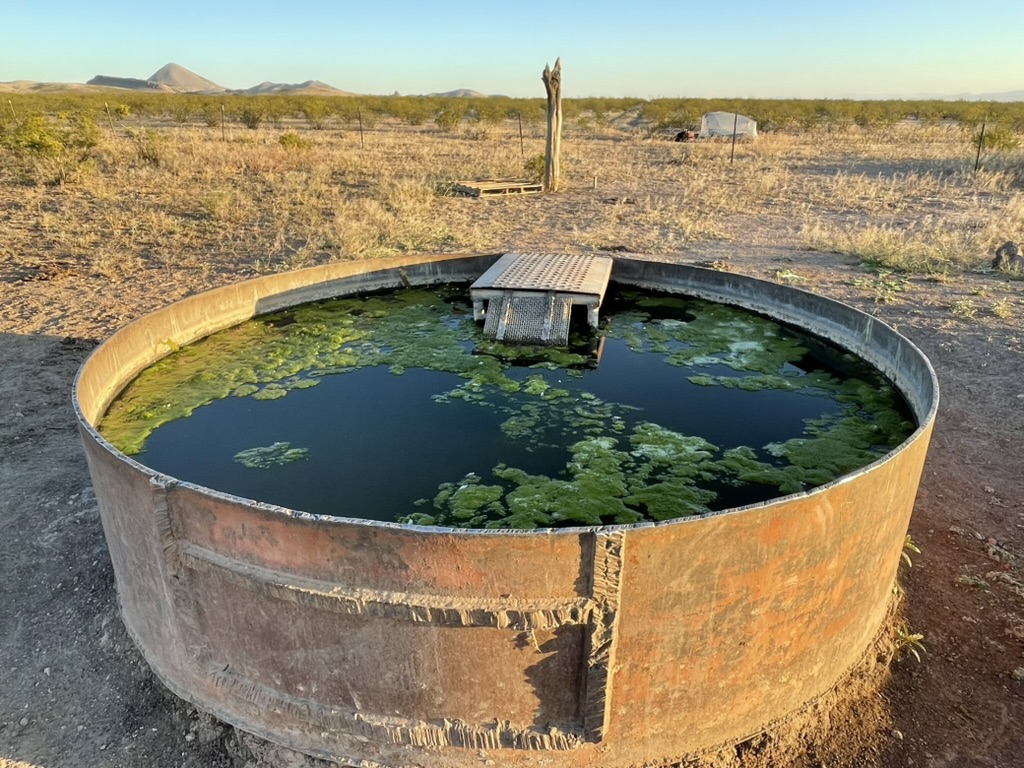
I see both of you lingering near a cattle trough, seemingly inspecting its potential as a water source. You both look, seeing me walking by, about 40 meters away. I raise my hiking stick into the air, a gesture of greeting, and you respond with waves. I have never seen either of you before. Never-the-less, I call out, “there’s a good water source about a half mile north of here.” I am thinking that the water in cattle troughs almost always has green scum growing and floating on the surface. I remember that my map indicated a good stream to the north. Less than an hour later, the three of us sit in the shade of some trees on the bank of this stream to the north of the trough. As with so many other similar occasions on a pilgrimage or long-distance hike, you each remain you. No name has been given, no identity other than hiker or pilgrim exchanged. Not yet named you remain a mystery to me as I remain a mystery to you. In the thickness of mystery we meet, encounter one another, grow in fellowship. Naming begins to dissolve the mystery, transforming you, encompassing you the other, voiding you as transcendent.

Buber writes in regard to the you becoming “an object among objects,” “the natural being that only now revealed itself to me in the mystery of reciprocity has again become describable, analyzable, classifiable.” “The human being who but now was unique and devoid of qualities, not at hand but only present, not experienceable, only touchable, has again become a He or She, an aggregate of qualities, a quantum with a shape. Now I can again abstract from him the color of his hair, off his speech, of his graciousness; but as long as I can do that he is my You no longer and not yet again.” (68-69).
Transforming you alters my relationship, thrusts me from being present with you. Buber writes, “The I of the basic word I-It, the I that is not bodily confronted by a You but surrounded by a multitude of ‘contents,’ has only a past and no present.” (63). I in the relationship with a you am fully present, they are present together and thrive in fellowship. The I not bodily confronted is not present with its object for there is no living reciprocity. There is only the object as a means to my project. Naming you is the beginning of this transformation, a gesture toward objectification. My own name initiates my objectification of myself. That is, while I and you encounter each other otherwise than through a name, there is no inward turn. The moment I realize my own name begins the inward turn, the turn away from the other who is my you, the turning into myself where you cannot follow. I have a name so you have a name. I turn toward the name that is not my you but my projection directed by the naming. Buber writes, “Whoever says You does not have something for his object. For wherever there is something there is also another something; every It borders on other Its; It is only by virtue of bordering on others. But where You is said there is no something. You has no borders” (55).
Buber, Martin. I and Thou. Translated by Walter Kaufmann. New York: Simon and Schuster, 1970.
Birds of Prey, Jones Creek
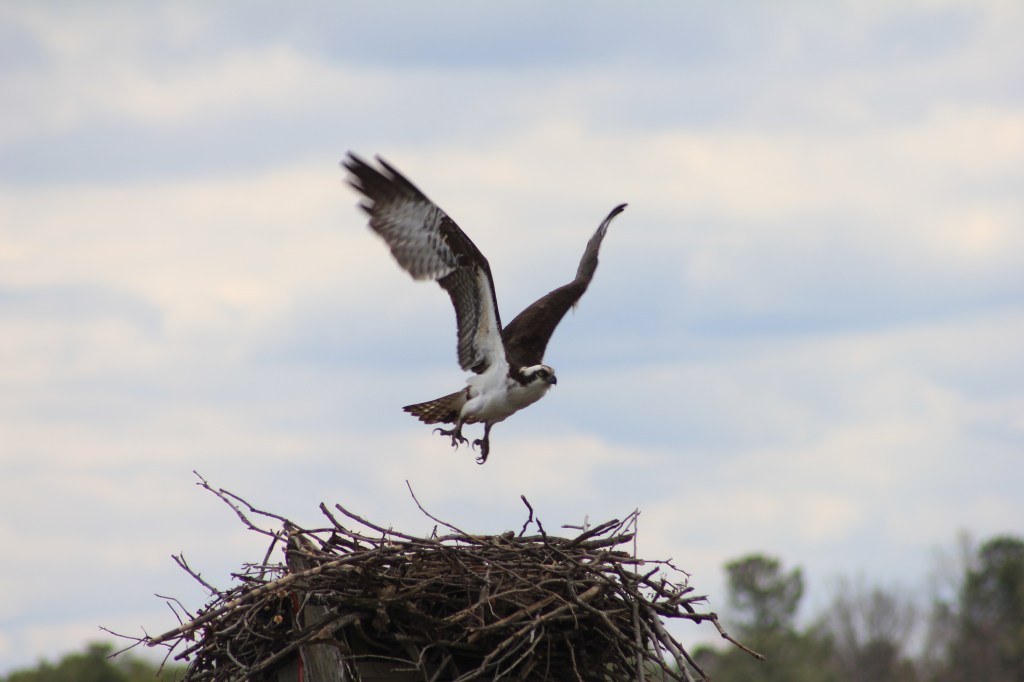
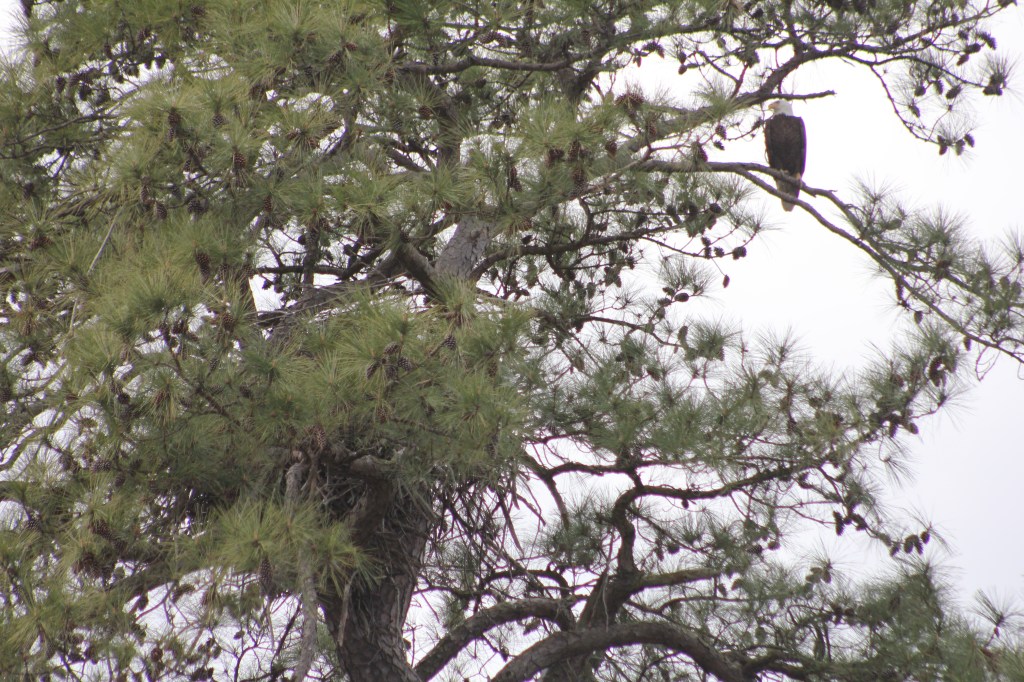
Two osprey perched atop a channel marker in Jones Creek near Rescue. The old nest has been empty all winter and this couple rebuild, taking turns on outbound flights to return with sticks for constructing the nursery. At one point the male flew up onto the back of the female and gently held her head with his beak; a little foreplay to break up the morning work project. A couple of hundred meters to the west, high up in a pine tree standing above the tidal marsh, I glimpse movement. A massive bald eagle nest, the boughs of the pine tree obscure my view but it seems to be one of the partners sitting. Could there already be eggs? The temperature is still below freezing on this third day of spring; I guess the eagles must be vigilant about their life work today?
Climbing Whitetop
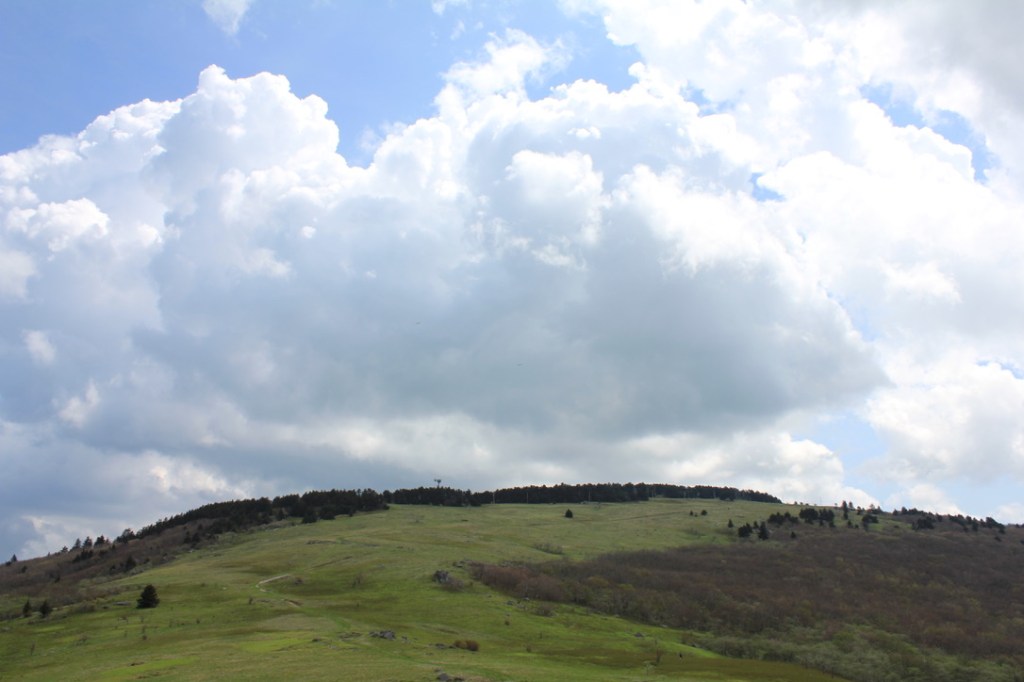
Great thunder clouds building to the east, rising high into the atmosphere above Whitetop Mountain. The sharp clap of storm energy announces the awakening. I retreat to my tent and the sky lets loose, squeezing moisture from its condensed cloud formations. Rain pelts down into the night and I sleep to the rhythm of drops drumming my fly. I wake early in the first brightening of the day, not knowing whether clouds and rain still curtain the blue. Exiting the tent I look northeast and see more glow, announcing a clear sky.
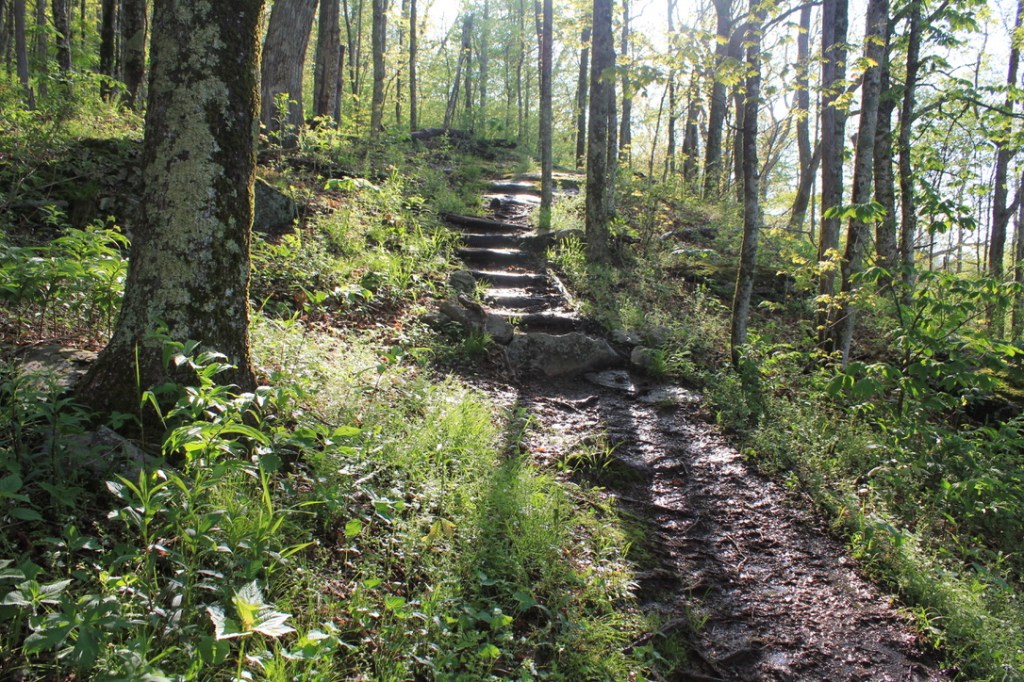
I leave camp before the sun rises over the left side of Beech Mountain, climbing into a cow pasture and breaking for my first meal. Birds have been calling out as I walked up the trail. Streams are full and running from the gusher last night. Sun rays penetrate the young canopy of trees, reflecting on wet stones and rivulets in the trail.
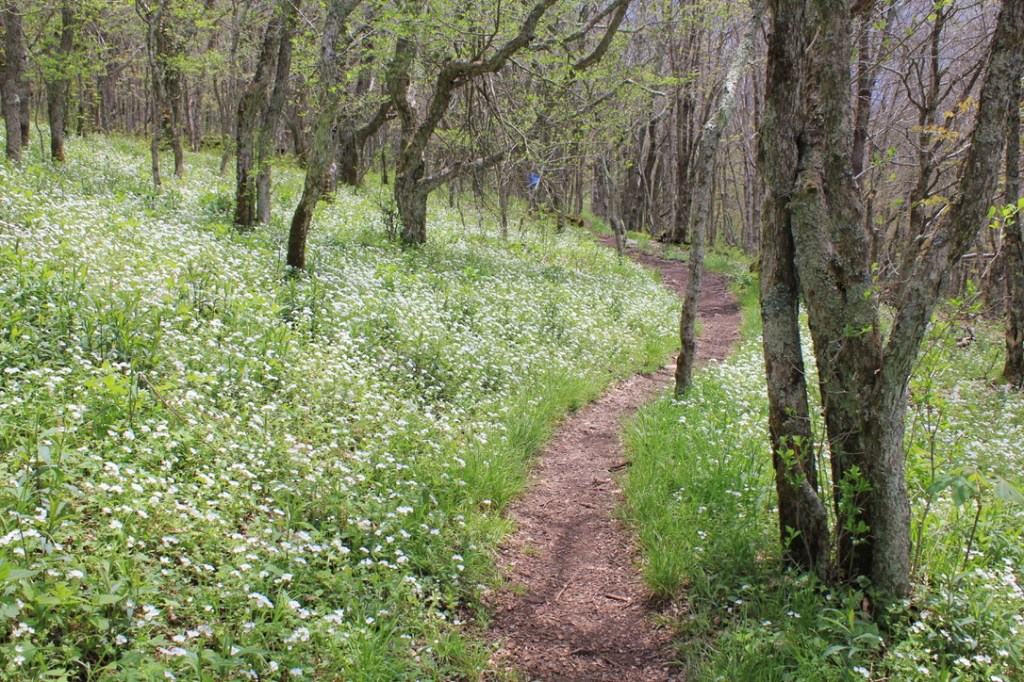
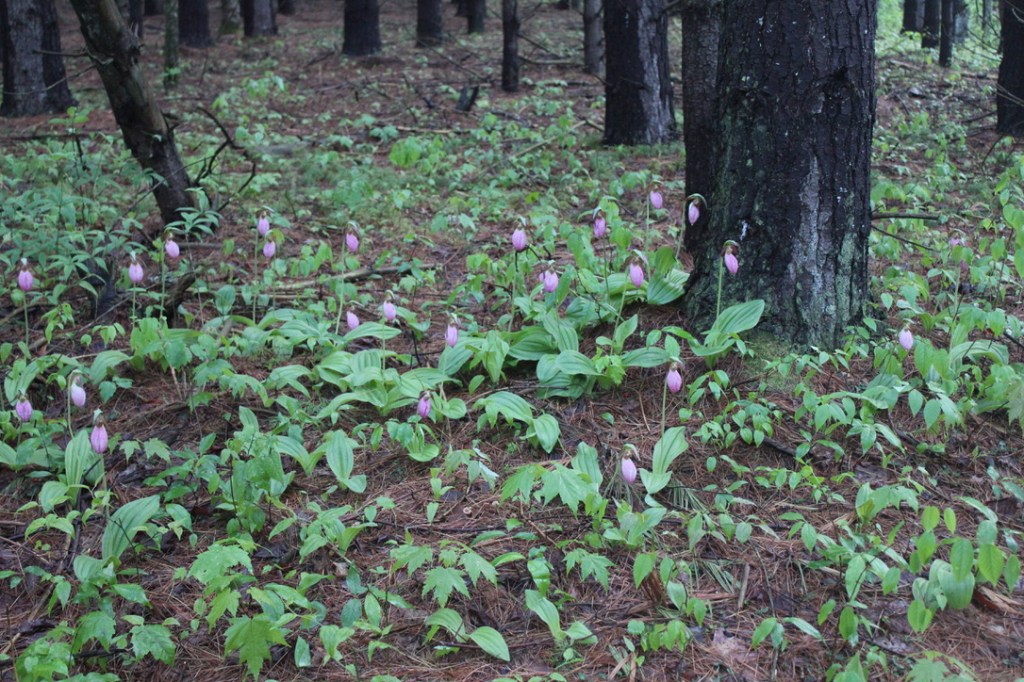
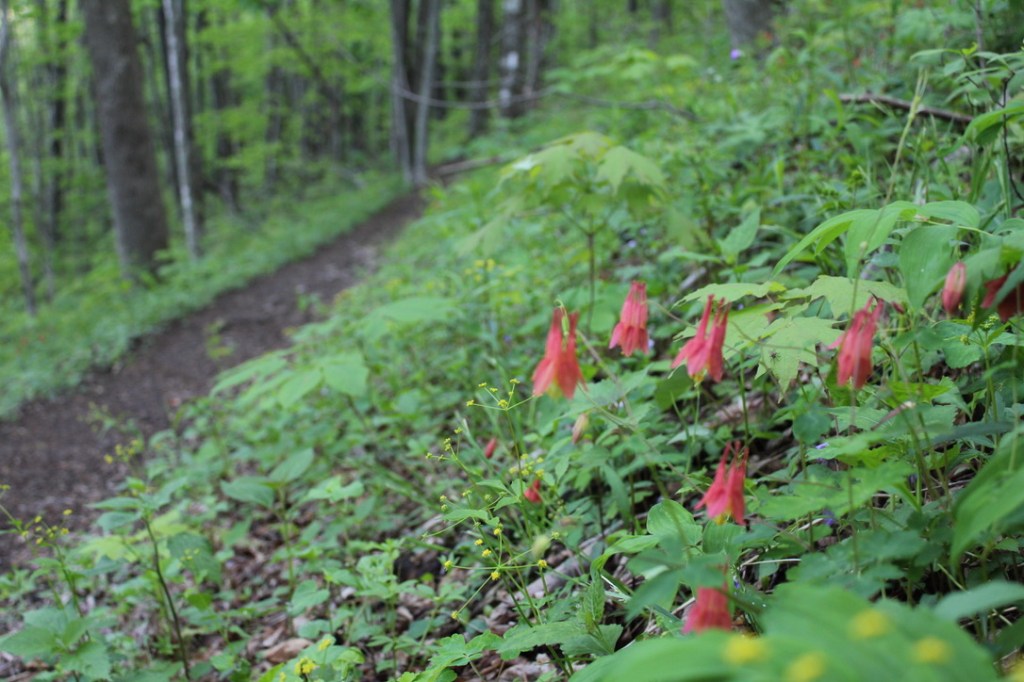
Wild flowers of white, lavender, pink, yellow, blue and red proliferate in a sexual dance. I breathe in the reproductive pollen that sails on the wind. Life surges in the plants as they drink sky nectar and show their attractive colors to insects who participate in the fertility rite. I feel life pulsing through my body with each breath, each stride, muscles swelling. I am hungry for life and its source. I climb higher, closer to the ground swell of being.
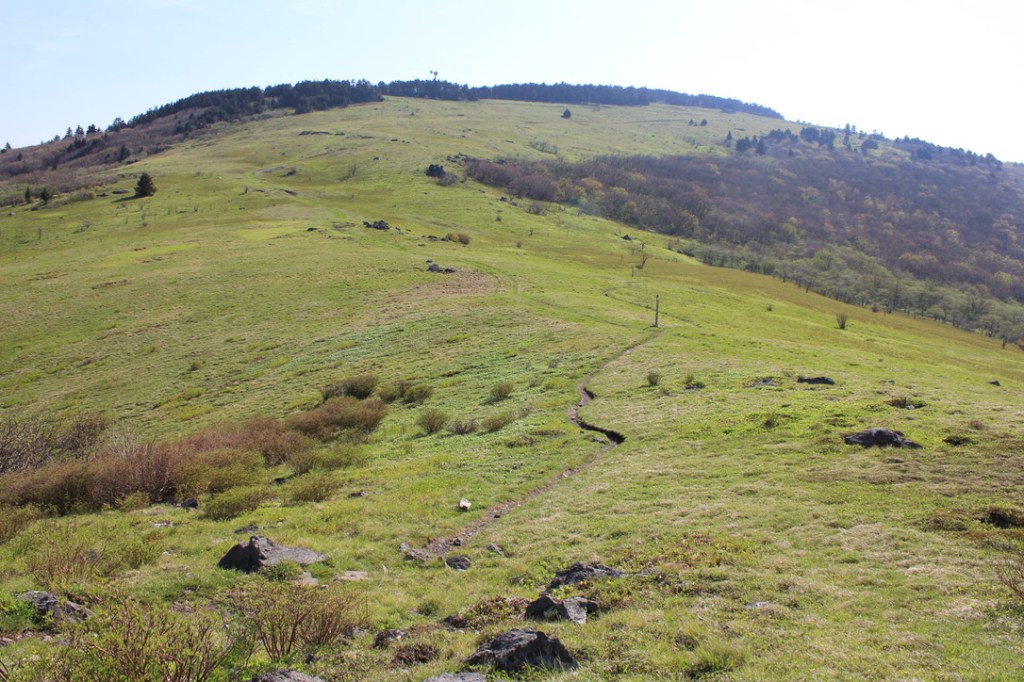
I reach Buzzard Rock, named for those birds of death but perched over the world teaming with life. I lay in the grass, warmed by the ever-rising sun. I watch the eternal play unfold, the ever-fluxing sky change from clear blue to an occasional small white cloud, and then to building cumulus pillows. Clarity rings in the atmosphere and in my soul.
 Kip Redick